This post is mainly for those of you who are new to the practice of neon tube bending, and it’s about the difference between lead-free and leaded tubing. Or to be more specific, why you should not practice learning to bend neon using lead glass. Being newer to neon you may not even be aware that there are two different types, but the glass produced to make neon tubing used to contain lead. Around the mid-late 2000s, manufacturing regulations changed regarding the use of lead in glass tubing, and by 2010 only lead-free glass was being produced. It took about 10 years for the inventory of lead glass neon tubing to disappear from the shelves of sign suppliers and distributors, and now if you purchase new glass tubing for neon bending it is only lead-free glass that's available. This is important to know, because how you work the glass in the fire and how it behaves is different between the two types, and it requires adjusting your fires and modifying your bending technique in order to get the same results. It’s not a huge difference between the two types, but it's enough of one that I know of neon benders who got out of the business when the transition happened because they couldn’t adapt to the change. I also know of benders who left the trade years ago but decided to get back into it in recent years and are struggling as they try to re-learn how to bend with lead-free tubing. If you are practicing your bending and don’t know which type of glass you are using, or if you are bouncing back and forth between lead and lead-free while you are bending, you are going to struggle and your progress will be slow and frustrating. By now, you might be wondering what the difference is between lead and lead-free. Simply put, the older tubing that contains lead is easier to bend. It softens at a lower temperature and cools down slower, which gives you a longer working time to shape the bends. Lead-free tubing has a higher melting point and quicker cooling time and requires that you adjust your torches and work a little faster. If you are a beginner, make sure you know which kind of glass you are working with. There are a couple of different ways to check. The first (and probably the most common) is to turn the gas way up on your crossfire. If the glass starts to turn black as it gets hot, it's lead glass. Lead-free tubing does not turn black in the flame, no matter how gassy your flame is. In fact, you’ll need to crank up that gas if you want to get a good nice hot bend with lead-free glass. 


 Another way to tell the difference between the two types which doesn’t require heating the glass is to look at the end of the tube. Lead-free tubing looks bluish/green on the end.

Obviously, you’ll need to have a sample of each type of glass in order to compare the two.  Here's another example.

Something important to mention when it comes to bending lead-free tubing is that you should make sure to wear didymium glasses. Not only will they protect your eyes from the sodium flare, but it also makes it much easier to see how the glass is heating and when it's time to make your bend.

Even though you can’t buy lead neon tubing new anymore, there is still enough of it out there that you will likely come across some. You can find it in old inventories of closing neon shops, or sometimes it’s donated to teaching facilities that use it for workshops or classes. If you are an aspiring tube bender and get your hands on some old lead glass stock, or maybe even some old dirty tubing that’s not good enough to use for jobs but you think it might be good for practicing your neon bending with, my suggestion to you is…DON’T DO IT!! It will give you a “false sense of ability”, as I’ve heard one seasoned bender put it. If you use lead glass to practice your neon bending (and maybe even get to the point where you’re thinking you are getting pretty good), as soon as you go to buy some neon tubing for a project and all you can get is lead-free, you will quickly find out that you are not as good as you thought and feel as if you are taking steps backward, becoming frustrated as you re-learn how to bend neon. In my opinion, learning to bend neon is hard enough as it is and it’s just not worth the aggravation trying to learn using two different types of glass. Do yourself a favor and set yourself up for success by using only lead-free glass for your bending practice. It makes sense to learn using the material that is currently available to buy (lead-free.) It might be harder, but once you become proficient at bending lead-free neon tubing, then if you do ever have the occasion to use the old lead glass you'll find it easier to adapt and with a simple adjustment of your fires, the glass will bend "like butter."

More information about working with lead-free tubing can be found here. https://www.brillite.com/UserFiles/File/Lead-Free_Tech_Bulletin.pdf

I would love to hear about your experiences working with either type of glass, so feel free to comment below!

When I was in junior high school and the dinosaurs roamed the earth, I had requested and received some aircraft engine information and promotional materials from Teledyne Continental Motors.  (Yes, I was a weird kid…now I’m just weird.)  One of the items they sent me was a t-shirt from their factory safety department that read “Safety means never having to say Ouch!”  It is a slogan I have remembered and tried to embrace for many decades since.  There are many hazards we deal with in life both at our work and outside of it.  It is an inherent part of “doing” anything….and when the doing involves any mechanical or electrical task, the consequences of a mistake or hasty action can be severe.  While our neon activities don’t often involve heavy mechanical tasks, the construction of our shop spaces and maintenance of our equipment often can entail a bit of this.

Rather than try to cover every sort of scenario with a lot of specific (and, lets face it, sometimes eye glazing) advice I chose to condense and reiterate a general talk I once gave on the topic of proper tool use.  It is really more of a set of guidelines to instill a good mindset and I felt it worthy of a few minor revisions to present here as well:

Many of us have had our share of minor bumps, scrapes, and burns and although such accidents are sometimes inevitable most are preventable. Often what makes the difference is having the right mindset and taking the time to properly assess the situation before acting.

With regard to tools, this can be aided by asking yourself a few simple questions:

 
1.) What exactly am I trying to accomplish at this step?

(STOP and look at what you are trying to do at each step: perform an overall assessment of the situation, including surroundings, to decide how best to accomplish the task…This not only prevents accidents but more often than not makes the job go faster and with less effort—efficiency and laziness do sometimes go hand in hand!)

 
2.) Am I using the best tool for the task and am I using it correctly?

(The wrong tool, or even the right tool used improperly, can make a simple task far more difficult or dangerous than it needs to be…If using an unfamiliar tool, make sure you have been instructed in its proper application and use…a screwdriver should never be used as a pry bar, for example. This item should also be double checked—many of us pick up bad habits along the way or have a temptation to use a shortcut—often because an object or tool is already in hand and just because something worked the last 100 times does not necessarily mean it was right or safe, it could just mean somebody has been lucky.)


3.)  Is the tool in good, serviceable, and safe condition?

(A classic example, a dull knife is far more dangerous than a sharp one.  Why?....because it requires more force to make it cut, thereby increasing the likelihood of your hand slipping from the handle and being cut by the blade.)

 
4.) Have I properly positioned myself to perform the task?

(Awkward positions often lead to unsatisfactory results, both in terms of the work quality and in accidents...not to mention the aches and pains of muscle strain the following day....I promise you that the older you get the more you will pay attention to this!.....if dealing with something that may cause injury by moving suddenly or breaking loose, ask yourself "Have I left myself an out?"…no one wants to fall backwards when the wrench they tugged on finally and suddenly moves or scrape their knuckles if they pushed on the wrench and it broke free!)


5.) Am I using all of the appropriate protective equipment?

(Goggles, gloves, etc. …and not just for you, but for any onlookers who may be observing your work.—it is your responsibility to keep bystanders a safe distance away or halt work that may be hazardous to them until they are briefed on the work and are wearing proper gear as you are......you instantly cease to look cool if you hurt the people who were impressed by what you were showing them just a moment before.)

After a while such analysis should become second nature and done so readily as to appear effortless. Although some accidents will still happen, the frequency and severity of them can be reduced. If you are working on something and have a doubt as to the best way to accomplish the task, ask someone to take a look...chances are everyone knows somebody who has encountered a similar problem before and you may gain the opportunity to learn from another’s experiences. (and mistakes)  Getting something done is great, getting it done without pain and while making it look easy is a sign of a true master.

Here's to never having to say, "Ouch! (@#$$%%&^&!!!)

-rh

I have a Daco pumping system in my neon shop which I bought years ago. Even though I purchased it used, it came with all the manuals, which I have saved, and I thought they could be useful to folks who have acquired some Daco equipment, but don’t have any information to go with it. And since they went out of business a long time ago there is no one to call and ask questions. Well, owners of Daco equipment you are in luck! I have scanned all of the Daco product information that I have saved and uploaded it to the NMG library. You’ll find installation and operating manuals for their manifold, diffusion pump, temperature and vacuum gauges as well as information for troubleshooting o-ring connections, electrode sizing, bombarder wiring and their recommended processing procedure. In addition to the Daco material, I uploaded files including technical data on glass, and a couple of vintage articles from Sign Builder Illustrated Magazine. One of them is an interview with my neon teacher, Haley Ryane, about her experience teaching neon and running her neon school for 17 years. If you haven’t visited our library lately, click on over and check it out. You can browse the files or use the search function if you are seeking something specific.

 Do you have a suggestion for something you’d like us to include in the Neon Maker’s Guild library? Add your comment below and we’ll see what we can do! 


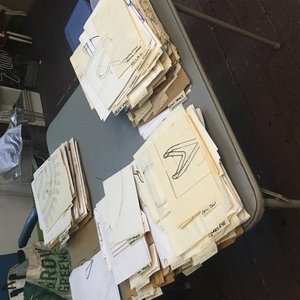
I recently reorganized my neon patterns, and also changed the way I was storing them.  I had accumulated quite a few after 22 years in my studio and it was starting to become an issue! I was storing them rolled up and they were getting messy and hard to locate one when I needed it.

Generally, I don't keep every single pattern from everything I make, but I do save most things in case I ever need to repair/remake a unit, and also just as a visual reference for projects to note glass color, diameter, and footage amounts. (I also have a notebook that I keep for these things, but that's a subject for a future blog post!) I do keep all my patterns from my art pieces and also the jobs where I designed the artwork. I think since I make my patterns using an overhead projector to draw them by hand (rather than using a computer) I've become a little attached to some of them, even though I might not use them again. Most of the projects I tend to do are physically small (with the patterns not being more than 3'x5') so I decided to change from storing them rolled up to folding them flat, thinking that would work out better. And I was right!

When I worked in neon wholesale shops, it was common to store the patterns rolled since most of those jobs were channel letters, and the patterns were typically over 18" tall and several feet long. When I started storing my neon patterns in my studio, I just rolled them since that's what I was used to, but because most of my patterns are on the smaller side they just became a big mess of little rolled tubes. :) The flat and folded system is so much better!

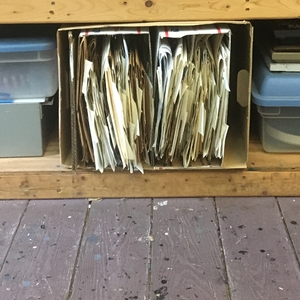
The process of switching from rolled to flat involved sorting through all my patterns first and purging the ones that I knew I would never ever need again, which ended up being about 1/3 of what I had.  After I whittled down my collection, working on a small bunch at a time, I unrolled them and trimmed off the excess paper from around the edges, which helped to fold them smaller and flatter. After they were folded I made a tab for each one using 3" wide paper tape, with the name written on each one.

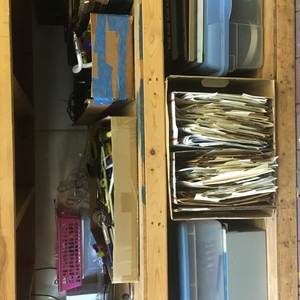
I was able to fit them all into one file box and store them neatly under my table. I like them so much better this way!

How do you store your patterns? I'd love to hear about it in the comments.

“What’s in a name?”  ...to paraphrase Mr Shakespeare, Would not a torch by any other name melt just as much?  A quick look through a hundred years of neon supply catalogs and a study of collected vintage torches helps shed some light in a sometimes dark corner of the neon shop.

When I took my first steps into the neon world, there were just a few seemingly straightforward names for the torches involved:  Crossfire, Ribbon Burner, and Hand Torch.  The crossfire, in my case, was the familiar 5 point type (actually 10—five per side) The ribbon burner was the ubiquitous Hyde style available in 6, 16, or 24 inch sizes and equipped with an adjustable slide and an economizer valve to cut it back to idle for both gas savings and to keep a cooler shop when it was not actively being used.  The hand torch was a simple 500T type used for small welds and tipping off.

I very quickly learned that these were not the only types out there.  7 point crossfires were available, hand torches with different styles and sizes of tips were available, and then there was the “knife fire” and “cannon fire” burners.  These latter items consisted of the BMT-7 or S-21N heads, respectively. 

One might believe that this is all rather straightforward…and if confined to US practice this is mostly correct…..but it is not really that simple and it becomes especially muddied if your neon experience is more global in nature or if it spans many decades, or- as is equally true in my case, delves into a more archaeological aspect.  Terminology is often not merely regional or temporal, but also rooted in the history of the labor force involved in the trade.

If one were to refer to a “cannon fire” burner to neon tubebenders in the US, the S-21N or McLennan style burner will come to mind.  Use this terminology to someone in Europe, and you will conjure an image of a large single burner, often on the bench and more akin to what is seen in a scientific glassblowing shop setting.  We often call these a “bench burner” but even this has not always been so.

Prior to WWII, it was not unusual to see these same torches referred to in supply catalogs as a “blast burner” and in one catalog I have seen both “cannon fire” and “blast burner” used for what outwardly appear to be nearly identical offerings.  No wonder it is easy to confuse people.

Part of the reason for the different torch types used between the US and Europeans is the glass type commonly used in neon work.  In Europe you see much more borosilicate glass used which requires an oxygen enriched flame—a set of crossfire heads closely pointing at one another would be more readily harmed by this additional heat, this is why the single larger burner is often used in that application.  This naturally leads to a question about the divergence of the bending style and tools used.  When neon became popular, there had been an established apprenticeship program in Europe for scientific glassblowing.  Many of the neon benders in Europe had been trained through this system and so it was a natural fit to carryover much of this knowledge into the burgeoning neon industry.  Such was not the case in the US at that time.  Instead, there was a rather active and large lamp and radio tube industry.  Much of it was undergoing a mass production transition just before neon hit the scene and one aspect of this was the preference for the use of soft glass in lamps and tubes and the advantage of the use of multiple torch heads (two opposing heads allow you to heat all the way around the glass when it is rotated 180 degrees, rather than a full 360 degree rotation needed with only one head) and so these types of tools were eventually adapted for the US neon industry.  (There is an interesting subset of the history of how this came about as it was not initially the case and it is worthy of more detail in its own right and I will try to do it justice in a future article.)

Even in the US, the burner terminology underwent some transitions and you see it reflected in catalogs over the years (sometimes the term “cannon crossfire” for the S-21N was used or even “hand crossfire” for the torches we use for tipping-off)  In this case it seems mostly just a shorthand rather than a major change.

And just before you thought it had escaped this phenomenon, even the ribbon burner has not always been known by this name.  At least in its case, however, the variation of terminology has been more consistently linked with its design rather than by regional influence.  Thus we have seen “Tubular Burners” and “Fishtail Burners” in addition to the now ubiquitous “Hyde” type burner, whose design and overall versatility pretty much became the standard in the postwar period on to today.

As the workforce and technology evolved, so too did the need for specialized tools and the regional names bestowed upon them.  With greater communication amongst the neon community around the world combined with the rise of ordering tools, materials, and supplies from far away places the need to understand these historical and regional names is of greater importance than it was just a few decades ago.  In this regard, browsing through a hundred years of catalogs and studying some of the vintage torches and burners I’ve used has helped illuminate that dark corner of the shop as well as exposing other dark corners to explore next.

I started learning how to make neon in Maryland back in 1989 when I took a 12-week course. I then worked in neon sign shops for about 10 years before opening Evening Neon so I could focus on my own projects and artwork. My path was pretty traditional for getting into the field of neon, and I was fortunate to have been able to learn during a time when more neon shops existed and opportunities were readily available. After LED’s came into the market in the early 2000s, the neon industry really took a hit. Around that same time, the change over from lead to lead-free tubing happened and coupled with the diminishing availability of neon making supplies a lot of neon shops ended up closing. Fortunately with the advent of platforms like Instagram, neon has become popular again! This is creating a new generation seeking to journey into the wonderful world of neon making but aren’t quite sure how to begin. Although there are still neon shops out there willing to take on apprentices, those opportunities are still pretty scarce. There are workshops and classes available at a few glass facilities and some colleges offer courses in neon as part of their arts program which is a good starting point but really only gives a “taste” of the neon making process. Even the neon schools which were prevalent in the 1980s were meant to only provide the basics, with the idea that when you finished the program you would further hone your skills over thousands of hours working in a neon shop. The reality is that unless you are consistently getting bending time in the fires, it’s very difficult to improve your skills and develop into a competent neon craftsperson. Learning neon glass bending needs to be a constant, ongoing activity. There are no shortcuts. This leaves many who are dedicated to learning neon tube bending to resort to what has become the default approach: set up your own torches, buy some glass to start practicing and try to figure it out on your own. That is a really difficult way to learn neon!! Working with hot glass is difficult enough, and without the knowledge and guidance of a skilled tube bender to facilitate the learning, it can become self-defeating real quick.

This is why I’m so excited about the Neon Makers Guild, an organization whose time has come. We want to create a place where aspiring beginners can connect with experienced benders and gain access to all of their juicy neon knowledge. Neon Makers Guild is a space where folks who are dedicated to the craft of neon making can share information, learn things and generally support each other in the spirit of generosity so we can all be the best neon craftspeople we can be. Social media has been a place for some of this connection, but as someone looking to spend LESS time on social media I’m excited to have somewhere to gather that isn’t going to treat me like a product and sell my data! We have a lot of great things planned for the Neon Maker’s Guild and I’m really happy to be helping build this organization and community.

Let’s all help to keep those neon fires burning! 

Ham radio folks, neon folks, antique collectors, book people, old car people, artists......ALL of them are hoarders.  And I am all of those.  And probably a few more that also fit the profile.  One item I've collected over the years is neon related technical books, old supplier catalogs, vintage shop notes, and equipment instructions.  Like...a LOT of them....over 10,000 at last count.  During the last 3 years, I started a project to scan them and eventually create some sort of accessible library for what has become very scarce information.  So needless to say, the fact that we now have the beginnings of a library here at the Neon Maker's Guild is a wonderful and exciting development given that the matter is near and dear to me.

The library section is just getting started and we are slowly adding to it.  More will be added as time and drive space permits.  If you go to the section to browse, it is not arranged by any category so who knows what you'll find as you walk the digital aisle.  If, however, you know what you are seeking, it is searchable and the functionality should allow you to access what you want to read.  When you seek the answer to a question that seems modern in nature you may be surprised just how much was known about it and how long ago that information was known.  Be they physical or digital, libraries are a most sacred space with the keys to many secrets.

If you seek a specific piece of neon information and lore and you don't find it in our library, PLEASE reach out to me....it is entirely possible that the information is in one of our collections and we've just not uploaded it yet.....and in the case of our not having it...I love a book and information hunt, and I'll make it a project to find it.

Enjoy your visit to our glowing shelves.

I've already revealed in the podcast that DJ and I host, that I LOVE dogs. Not just some dogs, ALL dogs. So it stands to reason that my pups would be in the shop with me. 

For those of you who are deciding whether or not you should bring your pup to your neon shop I'm here to help!

First things first - how well do you know your pooch? Have you recently adopted them? Or have you been together forever? In either case - make sure you know how your pup reacts to new situations.

Start with some noise desensitization. Prepare them for the sound of throwing glass you just swore at in a bin. Or when you crush down your bucket of glass (if that's your vibe). That way you at least know how they'll react and you can be ready to calm them if they scare easily. But hopefully they'll just roll their eyes at you whenever you make a loud or silly noise.

Make sure you can trust them not to eat all the shit on the ground. Some dogs are very orally fixated and need to feel with their mouths, whatever they find or smell on the ground. My 11 year old terrier is this way but ALWAYS spit it out. I know this because we've been together for 11 years. My two year old terrier on the other hand.....

We adopted our 2 year old terrier, Rhoda three months before COVID swept our world. And her personality is VERY different from our 11 year old, Reggie. We thought we had finally crossed the "eat every single thing that is in sight" hump but we were so wrong. One afternoon I saw an orange spec in Rhoda's poo - it was a jagged chunk of classic citrus glass! Naturally I panicked. She had no signs of internal cuts or bleeding, thank the Goddesses that she was a baby still made of rubber. This could have gone so much worse. To this day I'm so grateful it was all okay.

The no brainer - keep your floors swept. 

But also know your pups inclinations. They can be good at popping into those tiny crevices where the broom can’t reach. 

I also recommend lots of socialization too. You never know when someone will pop into your shop and you’re bending. Your pup will likely be more than happy to greet them before you. So I recommend building up some good manners. 

 Prep your shop and your pooch and gain the best neon assistant a person can have!

I'm the kind of person who takes things too seriously. I'm also usually pessimistic and hard on myself. Nothing is ever good enough. But I'm trying.

This pandemic has hopefully forced us all to reavaluate and take stock in our lives and ask ourselves what we want, who we want to be, where we want to go, because you can't take it with you and life is too short. I know it has for me.

I'm writing this to welcome you to (what I believe) is a new beginning. A new start to relationships, community, to what drives us. I want to believe that within our neon community and sign industry that we can now be open about sharing ideas and knowledge with each other. 

I reside in New England. Boston to be exact. And let me tell you, if you've never been here, the rumors are true: everyone is an asshole (for the most part). This has also been true withing the sign industry, generally speaking. People stab each other in the back, steal clients, and are just terribly awful to each other up here. I'd like to think that community is better than competition and we're also stronger together. Maybe it's just my view on the city and state, however, there are of course individuals who are the nicest people I've met, but collectively, phewwwww golly!  But one thing is for sure: reputations speak for themselves and we're better together.

So welcome to the Neon Makers Guild. Let's be bold. Let's be unapologetic about who we are. Let's do better. Let's lift each other up in this crazy world and 

Let's be OUTSTANDING in OUR FIELD!

It seems fitting to address this as my first blog post for the Neon Maker’s Guild, some of you may have read a version of this story on my personal blog page (www.novioljourneys.com) or heard it during one of the talks or presentations I have done for various groups. Nonetheless, it is fitting to reiterate some of it here and sum up by explaining why it is relevant to the guild.

I don’t know when I first encountered and became fascinated with neon signs and art. Likely it was during a family vacation as a kid. I have some vague memories of green zig-zag glowing tubes along the eves of some old motel we stayed at. I also vaguely recall the light buzzing of its exposed, and obviously not 100% properly functioning transformer. I can’t say for certain exactly where this was, or when it was… but most likely it was when I was somewhere between 5 and 6 years old… maybe 7. By the time I was in third grade, I ended up with a book that described how to build Tesla coils using neon transformers as the primary source. The photos in the book showed similar art-deco cased transformers to what I recall seeing at that old motel someplace in the past. This is, as far as I can recall, the likely first encounter with the glowing beauty of bent glass… it is also around this time that I moved past the simple electrical projects of my first and second grade years and began to build and tinker with many little high voltage projects such as Van De Graaff generators and Tesla coils… I was, and still am, “THAT” kid.

A decade or more passed and then I was in my freshman year of college. One day I saw a posting on a bulletin board in the commons: “Custom Neon Signs” with a phone number to call. My roommate and I thought it would be incredibly cool to have our own neon sign in the dorm. So I called and asked. Anyway… I naturally inquired about what it would cost to have a polite, lowercase, script writing neon “fuckoff” to hang on the wall. Why not, right? (Naturally you wonder WHY that, right?… well, you see, amongst my friends, this was a common greeting or comment. An odd term of endearment as it were. I still smile when a friend tells me “fuckoff” all run together as one word like that.) The price I was quoted was about $150.00… which, at the time, was a lot of money and completely out of the question. All was not lost in our quest for dormitory neon, however.

I understood how these things worked and correctly assumed that the labor of shaping the glass was the real expense involved, followed by the transformer and other materials. So I asked, “How much would it cost if I bent the glass and had you put in the electrodes and fill it with gas?” The response was that it was not nearly that simple. I said, ok… ”but how much?” After some back and forth, the man told me about 12 bucks, plus a transformer. “OK! Twelve dollars I could do! That’s what I want to do.” Again, I was told it was not so easy or simple but that if I wished, I was welcome to come over for a shop tour and to see a little of how neon signs and art are made. Naturally, I took him up on the offer and my roommate and I showed up within an hour or so.

When we arrived at his house and entered his shop, which was in the old Four-Square style garage building behind the house–whose address was “509”… I was confronted with the closest thing to a real “Frankenstein’s lab” that could exist in modern day. Torches and burners on articulated stands… layout benches… an elaborate high-vacuum manifold made entirely of glass… and a 10KVA power pole transformer mounted prominently … it was and still is, most impressive.

Steve, the owner, then demonstrated a few basic bends and torch techniques and discussed the overall process from start to finish. He also dispelled a common myth by demonstrating that glass was not nearly as fragile as we all believe. (I still perform the same demonstration for others when I make a double-back bend and bang it on the bench… and I often get similar looks of disbelief from others.) I then bought a pound or two of 10mm clear glass (about 8-10 sticks, each four feet in length) and took them back to the dorm with the intent of making something.

I tried a variety of burners and torches, even an altered campstove–all improvised and while functional, not really ideal for the task. I struggled. Steve was correct that this was not nearly as simple as one might be lead to believe. After trial and error… mostly error… I eventually did manage to create something: A simple mountain. Took it back to his shop, and he welded in the electrodes, pumped and processed the unit and filled with Argon and a drop of Mercury. Argon with some Hg added makes a beautiful brilliant blue. There is nothing quite like it. It was amazing and punchy… (on a related note I think part of why I like Van Gogh’s work and old Cibachrome prints is related to my love of neon–the contrasts of color are similar to me.) And it lead to finding an original 1935 edition of Miller & Fink’s “Neon Signs” book (THE how-to book of the era) … and then more creations… including some for others… and this eventually lead to setting up my own shop, careers in the sign business and in other areas where this valuable knowledge could be carried over to other projects.

Those initial visits to his shop and the quick lessons offered and questions answered, I later learned, was a VERY BIG DEAL at the time. Benders of a half century ago often did not want to train others or divulge much information. To this day I do not really know what it was that I said or how I said it, but I got a shop visit and some of my initial lessons, informal as they were, but sufficient to get started. It was, above all else, a kindness.

In subsequent years I have come to realize that I have a talent and passion for this work and for the passing along of the knowledge gained. I especially enjoy building shop setups, solving odd problems, and documenting the history of the technology involved. To that end I have built portable shops for teaching—some using only restored prewar components and tools, advised and consulted for others, and over the last several years been working on amassing a rather large neon related technical library that, while I am far behind on my scanning, now stands at some 14000 files and which I eventually hope to be able to make more widely available.

My hope for the Neon Maker’s Guild is that it will provide a further avenue to pay forward that small kindness afforded me all those years ago and spread good, concise technical and historical knowledge about neon and the related facets that go into it. The days of the secretive neon bender attitude may have seemed like a good idea 50 or more years ago, but in this century, our very survival is dependent upon this knowledge being freely available and properly interpreted for use.

Page 3 of 4
Page 3 of 4